The purpose of this tutorial is to help you to design and conduct an evaluation activity.
The intended learning outcomes for this tutorial are to:
You should complete the following activities prior to attending your tutorial:
Review the lecture content on Evaluation
Read the following chapters from Interaction Design: Beyond Human-Computer Interaction Chapter 14 Introducing Evaluation, Chapter 15 Evaluation Studies: From Controlled to Natural Settings (Rogers et al., 2023).
Write a forum post (100-200 words) summarising your research plan in preparation for Assignment 2. In your post, name the AI use context you have chosen to investigate, and explain why you selected it. Then briefly outline your research plan, including your strategies for data collection and the analysis framework(s) you intend to use. You must also include at least two references from relevant HCI literature—these could relate to prior studies in similar areas, research methodologies, conceptual frameworks, or other scholarly resources relevant to your topic.
Following on from the assignment work last week you should have:
For this week’s tutorial you need to create a plan for your study. Use your research skills to find examples of needs finding studies and studies of how people use AI tools (e.g., at CHI) and use them to help plan your study. Make sure your study plan is realistic.
Remember, for your study plan you need to collect quantitative and qualitative data so that you can report on an analysis of each type of data. You can choose what form that data is, e.g., quantitative data could be rating scale questionnaire questions, timed task completions, or number of clicks to complete a task. Qualitative data could be interviews, written reflections, images, videos, sounds, observations. For more ideas, see the lectures and the textbook!
Your pre-class task asked you to describe your planned study for Assignment 2.
Recall that the research question you will investigate is:
“What are the unmet needs, frustrations, and desired capabilities that students experience when using AI tools in a specific context of their life?”
As a class, discuss the following questions:
This section of the tutorial is dedicated to articulating an evaluation plan. You can choose to discuss your study plan from the pre-class task, or choose another type of user interface to evaluate.
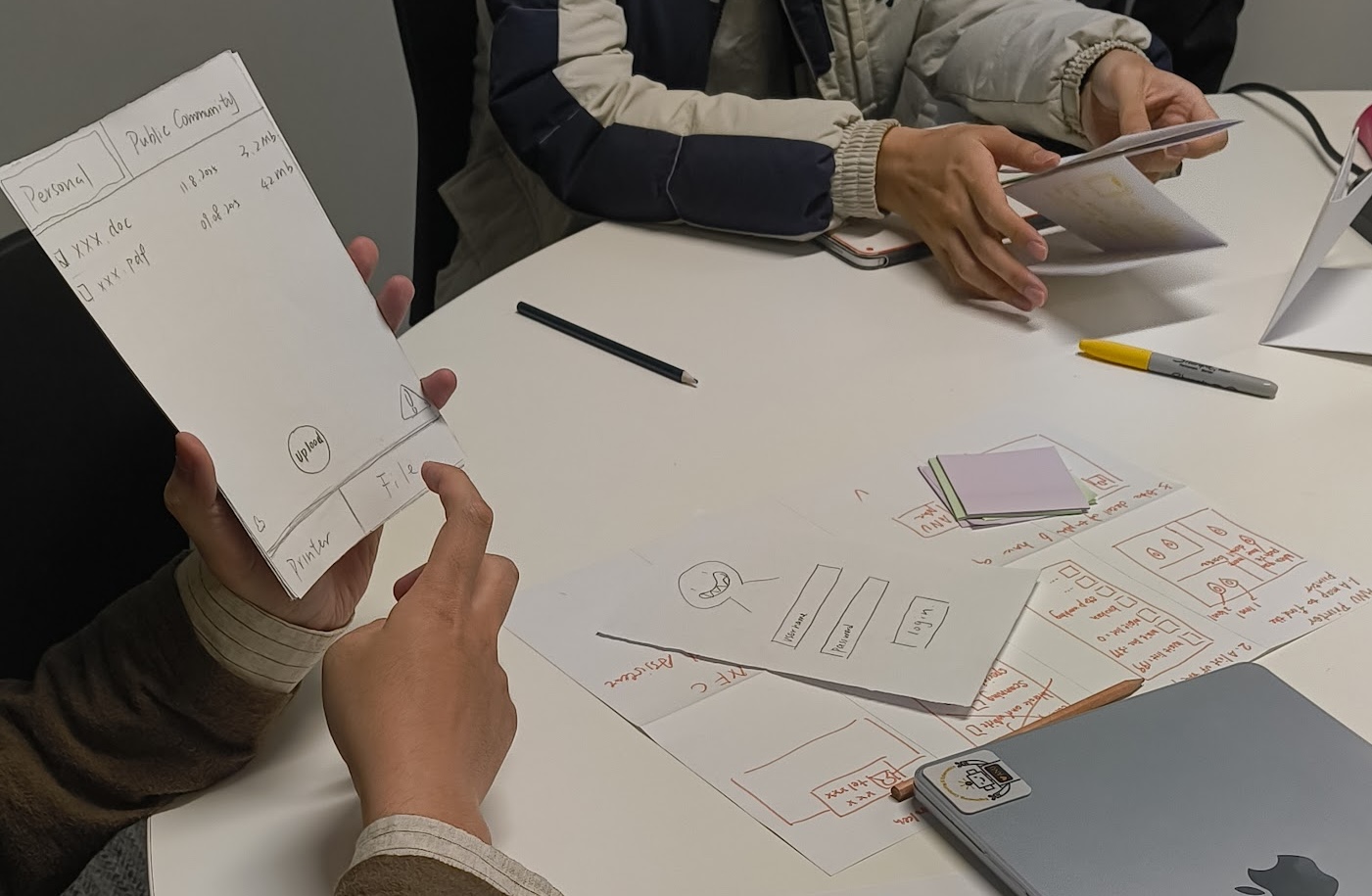
In groups, spend 10 minutes discussing each of the following aspects of an evaluation plan. Use a sticky note for each aspect. Make sure that everybody in your group has completed a stick note for each aspect!
Consider the goal of your evaluation and a task that your might ask users to complete.
Now it’s time to consider your data collection. Recall that we are expecting both quantitative and qualitative data collection and analysis.
After you have gathered your data, it’s time to analyse it.
As makers/learners/developers/academics/humans, it’s important to consider the ethical implications of any of our work. The key ethical questions for an HCI evaluation with human participants are (National Health and Medical Research Council (NHMRC) et al., 2025):
Note that “risks” in HCI, are usually not of physical harm, but could be related to privacy of the data collected or risk of being identified as a participant. Small studies often do not benefit the researcher very much, but it has been argued that we should expect more benefits to flow to vulnerable participants (Brown et al., 2016).
Informed consent for participation is a cornerstone of research on
humans (National Health and Medical Research Council
(NHMRC) et al., 2025). For some kinds of HCI research, the
concept of consent is complicated (Benford et al., 2015), but in your work,
you may wish to obtain consent in written form, or verbally. The idea is
to ensure that participants understand what the study involves and
clearly agree to participate given that knowledge. For Assignment 2, a
natural part of this process is asking each participant to write down
their uid and name for your Participants section
(- u1234567 Firstname Lastname) — consenting to be named in
your submission is part of what they are agreeing to, and it’s how
participation is verified.
In pairs, discuss how your study plan for the assignment aligns with these questions:
Summarise your ethical considerations in 4-5 sentences and post it on the forum. Your tutor will create a thread for your tutorial.
The last 30 minutes of this workshop is dedicated to meeting with your group and working out the logistics of completing your evaluations.
As a group you should: