This week, you’ll learn how to create a persona and scenario, and use scenario-mapping to generate and evaluate design ideas.
Observe someone you know (a friend or family member) using a digital product or service (e.g., an app, website, or device) in a real-life context. Write a 100-200 forum post answering these questions:
In this class, you will:
The tutor will bring up the pre-class responses on the big screen and lead you in a discussion. Some questions might be:
Your tutor will put you into groups of 5-6 students. In your group, choose an activity involving a digital product or service that a university student might do in their spare time (e.g. planning a trip, learning a new skill, managing finances, gaming, etc.).
Create a fictional, but realistic persona who engages in the chosen activity. Include relevant information, such as name, age, university background (e.g., course, year level), personality traits, goals, and frustrations. Draw a simple sketch of this persona.
For more on personas, consider these resources: Carden (2023); NSW Government (2025); Dam & Siang (2025) (see reference list below)
Choose one aspect of this activity and create a scenario. Your scenario should include these elements:
Ensure that your scenario includes the right amount of details (enough, but not too much). Refer back to the pre-class reading to see examples.
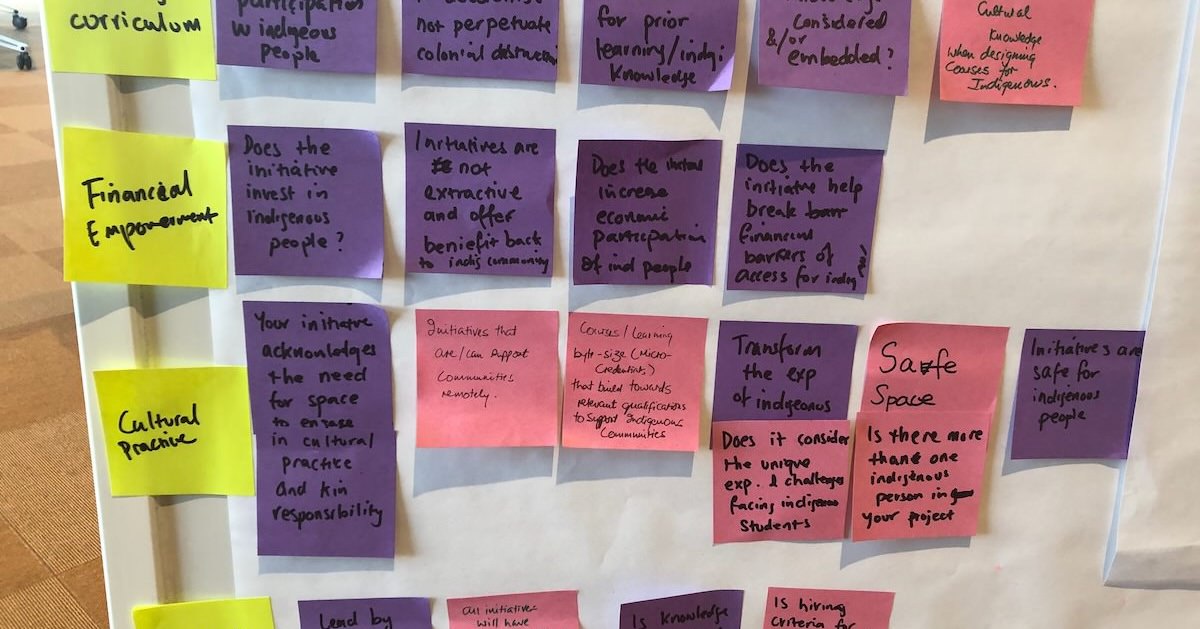
Scenarios can be powerful tools for generating ideas. In this activity, you’ll engage in scenario-mapping to generate ideas. Each group should take four different coloured sticky notes from the tutor.
Choose one colour of the sticky notes. Break your scenario down to 4-6 sticky notes. Place it on a wall horizontally.
Designate a different colour of sticky note for three different categories.
Each group member should take 15 minutes to individually brainstorm relevant design ideas, questions, or comments and considerations in line with each section of the scenario posted on the wall. Put your sticky notes up on the wall as you go. Your questions and comments and considerations can be in response to another group member’s idea.
At the end of this activity, you will see a wall full of ideas for discussions. Spend 5 minutes by yourself to review this wall. As a group, review each idea and quickly decide which ones should be explored further and which one should not. Make sure to go through each sticky note, acknowledging it, and discussing it, but discussions should be quick.
During this discussion, you can move the sticky notes around to:
Take a photo of the wall.