## Announcements

assignment 2 published [on Canvas](https://canvas.anu.edu.au/courses/11488/assignments/43580):

> Your challenge is to run a small **needs finding study** with 3–5 participants focused on your classmates’ use of AI tools. You will answer the research question: “What are the unmet needs, frustrations, and desired capabilities that students experience when using AI tools in a specific context of their life?”

- collect and analyse data and present research findings
- apply quantitative and qualitative data analysis
- research **other students** in this class (do not research folks outside the class)
- participant matching in labs/drop-ins
- **new:** clearer instructions to complete the assignment, [Markdown linter](https://github.com/igorshubovych/markdownlint-cli) provided in GitLab CI.

## Plan for the class

- Analytical frameworks (qualitative analysis)
- Interpreting and presenting findings
- Deep dive on *Reflexive Thematic Analysis* (needed for the assignment)
- Reflexivity and positionality statements

# Analytical Frameworks

- different approaches can guide qualitative analysis
- **granularity:** from fine-grained detailed analysis to broader scope examinations
- conversation analysis: fine granularity, examines detailed interactions in short conversation fragments
- systems-based frameworks: coarse granularity, broad group or organisation level analysis
- useful depending on the research goals
- **reflexive thematic analysis (RTA) is on this menu too** — it’s where most of today’s lecture goes, so let’s survey the alternatives first

## Conversation Analysis (CA)

<div class="columns">

<div class="column" width="60%">

- **CA:** examines the semantics of conversations, e.g., turn-taking and interaction
- e.g., compare conversations in different settings
- markup with syntax to capture detailed interactions and speech patterns
- **Square brackets \[ \]** indicate overlapping talk between speakers
- **Round brackets ( )** show pauses in conversation with timing details (e.g., (1.1) = 1.1 second pause)
- **Physical spacing** represents temporal sequencing to show exactly when things are said in relation to each other
- aims to reveal subtle cues and conversational mechanisms that might otherwise be missed

</div>

<div class="column" width="40%">

    01  SUS i'd like to play beat the intro in a minute
    02  LIA   [ oh no: ]
    03  SUS [ alexa ][ (1.1)  ] beat the in[tro
    04  CAR      [ °yeah°; ]
    05  LIA                 [°no:::…°
    06  CAR (0.6) it' mother's day? (0.4)
    07  SUS it's (   ) yep (.) listen (.) you need to keep
    08    on eating your orange stuff (.) liam
    09    (0.7)
    10  CAR and your green stuff
    11  SUS alexa (1.3) alexa (0.5)=
    12  CAR             =°and your brown stuff
    13  SUS play beat the intro

Conversation with family members and Amazon Alexa with markup from ([Porcheron et al., 2018](#ref-porcheron-voice-interfaces:2018))

</div>

</div>

## Discourse Analysis ([Rogers et al., 2023](#ref-rogers-beyond-hci:2023))

- Analysing dialogue: what is said, how words convey meaning
- Interpreting context, psychological and social aspects of words.
- Language as social reality, open to interpretation
- [**Constructivist approach:**](https://www.open.edu/openlearn/health-sports-psychology/critically-exploring-psychology/content-section-3.1) Language as a constructive tool: analyse the process of world construction
- Identify subtle and implicit meaning between sources

## Content Analysis ([Rogers et al., 2023](#ref-rogers-beyond-hci:2023))

<div class="columns">

<div class="column" width="60%">

- Classifies data into categories and studying frequency of occurrences
- Applicable to diverse media formats including text, video, images, etc
- can involve predefined frameworks or classification systems to systematically examine content across specified dimensions
- can be combined with other analytical techniques such as sentiment analysis

</div>

<div class="column" width="40%">

<figure>
<img src="img/kaleidico-3V8xo5Gbusk-unsplash.jpg" alt="Analysing some content (Photo by Kaleidico on Unsplash)" />
<figcaption aria-hidden="true">Analysing some content (Photo by Kaleidico on Unsplash)</figcaption>
</figure>

</div>

</div>

## Interaction Analysis ([Jordan & Henderson, 1995](#ref-jordan-interaction-analysis:1995))

- investigate human interactions with each other, artifacts, and technologies using video recordings of naturally occurring activities
- can be teamwork: researchers watch videos together, discuss in real-time
- coding and annotation through repeated video playing
- hypotheses based on observable participant actions and behaviors
- find patterns inductively by assembling instances of salient events

## Grounded Theory

Grounded Theory (GT) is an *old and important* qualitative analysis technique ([Corbin & Strauss, 2014](#ref-corbin-strauss-grounded-theory:2014); [Glaser & Strauss, 1967](#ref-glaser-strauss-grounded-theory:1967))

- main idea: identify *categories* (a kind of theme) through iterative data collection and analysis.
- any kind of data but often ethnographic and interview data
- analysis procedure:
  - *open coding*: categories, properties and dimensions discovered in data
  - *axial coding*: systematically establishing categories/sub-categories
  - *selective coding*: refine and integrating categories
- *heavier and less flexible in comparison to Reflexive Thematic Analysis* (not suggested for first-timers)
- Rogers et al. ([2023](#ref-rogers-beyond-hci:2023)) claim GT “uses reflexive thematic analysis” — don’t believe your textbook. GT is from 1967, “reflexive TA” was named in 2019 ([Braun & Clarke, 2019](#ref-braun-reflexive-thematic-analysis:2019)), and what they describe is constant comparison.

## Grounded Theory Example: Idle Games

<div class="columns">

<div class="column" width="50%">

<figure>
<img src="img/grounded-theory-example-1.png" alt="GT process for Alharthi et al. (2018) in Rogers et al. (2023)" />
<figcaption aria-hidden="true">GT process for <span class="citation" data-cites="alharthi-idle-games:2018">Alharthi et al. (<a href="#ref-alharthi-idle-games:2018" role="doc-biblioref">2018</a>)</span> in <span class="citation" data-cites="rogers-beyond-hci:2023">Rogers et al. (<a href="#ref-rogers-beyond-hci:2023" role="doc-biblioref">2023</a>)</span></figcaption>
</figure>

</div>

<div class="column" width="50%">

<figure>
<img src="img/grounded-theory-example-2.png" alt="Codes and categories: Fig 9.11 Rogers et al. (2023)" />
<figcaption aria-hidden="true">Codes and categories: Fig 9.11 <span class="citation" data-cites="rogers-beyond-hci:2023">Rogers et al. (<a href="#ref-rogers-beyond-hci:2023" role="doc-biblioref">2023</a>)</span></figcaption>
</figure>

</div>

</div>

## Reflexive Thematic Analysis

- A newer qualitative approach for coding and theming: first Braun & Clarke ([2006](#ref-braun-thematic-analysis:2006)), now Braun & Clarke ([2022](#ref-braun-thematic-analysis:2022))
- Has become the default in HCI and many fields accessing qualitative methods
- Simpler approach than GT although shares some aspects
- Distinguished more by commitment to theoretical awareness and acknowledging subjectivity than to a particular technical practice or kind of data.

> Braun & Clarke call RTA a **method**, not a methodology: unlike CA or GT there’s no single built-in theory; you bring your own epistemology ([Braun & Clarke, 2019](#ref-braun-reflexive-thematic-analysis:2019))

*much more on this shortly…*

## Systems-Based Frameworks

<div class="columns">

<div class="column" width="60%">

- large projects involve many sources of data and stakeholders
- e.g., hospital, corporation, local council, airport, (or university…)
- need ways to understand how the system works together
- manage complex interdependencies
- common theme of management speak: “systems thinking”

</div>

<div class="column" width="40%">

<figure>
<img src="img/guerrillabuzz-7hA2wqBcSF8-unsplash.jpg" alt="Some kind of system… to be analysed. (Photo by GuerrillaBuzz on Unsplash)" />
<figcaption aria-hidden="true">Some kind of system… to be analysed. (Photo by GuerrillaBuzz on Unsplash)</figcaption>
</figure>

</div>

</div>

## Socio-technical Systems Theory (STS)

- **STS:** technology and people in a work system are interdependent ([Klein, 2014](#ref-klein-sociotechnical:2014))
- treat the whole system as a whole, applied in complex work places.
- More of a philosophy than a methodology, a holistic perspective to address challenges.

### Notable aspects:

1.  Task interdependence
2.  Socio-technical systems are “open systems”: influenced by environmental factors
3.  Heterogeneity of system components: subsystems have different technical components
4.  Practical contributions: analysing systems, evaluating changes, designing co-optimised systems
5.  Fragmentation of design processes

## Distributed Cognition of Teamwork (DiCoT) ([Blandford & Furniss, 2006](#ref-blandford-dicot:2006))

- Distributed cognition unpacks how multiple people and technologies interact complete tasks and solve problems.
  - **information flow model**
  - **physical model**
  - **artifact model**
  - **social structure model**
  - **system evolution model**
- models have underlying principles, e.g., for physical model:
  - **horizon of observation:** What an individual can see or hear
  - **perceptual:** How spatial representations aid computation
  - **arrangement of equipment:** arrangement of the environment affects access to information
- useful in collaboration contexts, e.g., software development, medicine

## Which Analytical Framework to Use?

<div class="small-table">

| framework | data | focus | outcomes | granularity |
|----|----|----|----|----|
| conversation analysis | spoken conversation recordings | process of conversations | how conversations are processed and progress | words or smaller |
| discourse analysis | speech or writing | how words convey meaning | implicit or hidden meanings in text | word, phrase |
| content analysis | written text, video, audio, images | how often something is featured or is spoken about | frequency of items in text | words to artefacts or people |
| interaction analysis | video of activities | interactions between people and artefacts | how knowledge and action are used in an activity | artifact, dialogue, gesture |
| grounded theory | empirical data of any kind | building theory from a phenomenon | theory grounded in data | varying levels |
| systems-based frameworks | large-scale and heterogeneous data | large scale systems of people and technology | organisational insights | macro, organisational level |
| **reflexive thematic analysis** (today’s focus) | any qualitative data, esp. interviews | patterns of meaning across a dataset | themes constructed by the researcher | flexible, dataset-wide |

</div>

# Interpreting and Presenting Findings

## Big Research Writing Tip: Cite your methods

- Applies to research projects in this class and at Honours, master, PhD and research-focussed workplace
- Work with supervisors/mentors/managers to choose methodology and analytical frameworks
- Read and understand the framework from (recent) scholarly sources (not just `nngroup.com`)
- Change and evolution is allowed, but understand that there is a wealth of example and established approaches

## Structured Notations

Specific interaction information can be represented in a formal/structured way when presented.

- presenting information through formal notations related to particular domains
- e.g., music applications might involve musical notation or symbolic data formats
- could be related to an analytical framework (e.g., conversation analysis)
- tradeoff between precision and flexibility; structured notation can be precise but potentially less accessible to a reader or limited in scope

## Using Stories

Context of use and examples of user experience can be seen as stories or narratives.

- Participants tell stories during data gathering which can illustrate research findings.
- Observations can be framed as stories
- Stories can be written or in the form of storyboards or videos.
- Can be used to support research findings and provide authenticity.

## Summarising Findings

Overall advice about findings…

- Multi-modal is often good: combine styles such as stories, plots, data excerpts, numerical tables
- Developing plots and visualisations is critical and hard work, just like crafting text. We spend hours getting it right in Python/R!
- Important to balance the weight of a **claimed finding** against supporting evidence; however, doesn’t mean that small studies are not useful.
- Reviewers hate over-generalisation: careful with terms like “most,” “all,” “majority,” and “none” without justification
- Statistical claims require care to avoid misleading the reader

# What even is knowledge anyway?

## What is knowledge?

By this stage, you could be excused for being a bit confused about qualitative research in HCI.

- Research is often defined as “knowledge creation”, but it’s not always clear *what* that knowledge is in HCI:
  - Is the knowledge from an interview different to a measured interaction?
  - Does our interpretation matter?
  - Do the users have to be objective?
- E.g., if you create a new app, and then evaluate it, can your evaluation ever be objective? (remember you created the app in the first place!)
- Not a new question: *epistemology* is a (philosophy) discipline to understand knowledge.

## Epistemology

This may feel firmly off topic, but we need to surface some friction about *knowledge* to properly explain the different approaches in qualitative research.

- **Positivism/Post-positivism** an objective reality exists and can be known through systematic, generalisable methods. The “post” bit concedes observation is never perfectly objective
- **Interpretivism:** knowledge can be socially constructed and meaning made by people
- **Critical theory:** examine power structures and hidden inequalities
- **Constructivism/Constructionism:** knowledge is created and shaped by human experience and social interaction, including with the researcher
- **Pragmatism:** apply frameworks that work best to solve the problem (e.g., mixed methods research)
- **New-Materialism:** *things* can create meaning too with HCI defined by intra-action ([Barad, 2007](#ref-barad-meeting-universe:2007)) of things and people

## “Bring your own epistemology”? RTA’s flexibility has limits

- RTA is *theoretically flexible*: no single built-in theory — but “there’s no such thing as atheoretical TA” ([Braun & Clarke, 2022](#ref-braun-thematic-analysis:2022)): you choose a position and declare it
- the flexibility is bounded: RTA lives inside the *qualitative paradigm* — subjectivity is a resource (not “bias”), analysis can’t be “objective”, themes don’t emerge
- positivist-flavoured TA exists (codebooks, inter-rater reliability) — for Braun & Clarke that’s a *different method*, and unacknowledged slippage is “positivism creep”
- so the real requirement is **coherence**: make your claims, quality practices and epistemology match
- Braun & Clarke’s own lean is relativist–constructionist — *declared, not required* ([Braun & Clarke, 2022, p. p188](#ref-braun-thematic-analysis:2022)): the book models the positionality it asks of you

## Activity: What should this mean to you

- Some aspects of HCI, e.g., “user experience” aren’t well uncovered by (post-)positivist frameworks.
- Interpretivist/Constructionist stances more popular in qualitative HCI research.
- New-Materialism/Agential-realism ([Barad, 2007](#ref-barad-meeting-universe:2007)) is emerging in HCI as a relevant mode of inquiry
- *but* this has some implications in terms of how findings are described!

<div class="talk-box">

**Talk:** 🧠🗣️ Does any of this make sense? What kind of knowledge would you want to deal with?

Discuss with someone near you for 2 minutes, then let’s hear some answers.

</div>

# Thematic analysis

- Let’s get into some more detail how to do *thematic analysis*
- Remember that this is a group of techniques!
- I’ll introduce *a* way of doing (reflexive) TA, adapted from Braun & Clarke ([2022](#ref-braun-thematic-analysis:2022))

## Phases of thematic analysis

<div class="columns">

<div class="column" width="50%">

1.  Familiarise yourself with the data
2.  Code the data
3.  Initial theme generation
4.  theme development and review
5.  theme refining, defining and naming
6.  writing up

The phase *names* here are the 2022 ones ([Braun & Clarke, 2022](#ref-braun-thematic-analysis:2022)); the table beside is the 2006 original. The process is the same, the renaming is deliberate — watch what happens to phase 3.

</div>

<div class="column" width="50%">

<figure>
<img src="img/reflexive-thematic-analysis_1_phases.jpg" alt="Table 1 of (Braun &amp; Clarke, 2006)" />
<figcaption aria-hidden="true">Table 1 of <span class="citation" data-cites="braun-thematic-analysis:2006">(<a href="#ref-braun-thematic-analysis:2006" role="doc-biblioref">Braun &amp; Clarke, 2006</a>)</span></figcaption>
</figure>

</div>

</div>

## Phase 1: Familiarise yourself with your data

<div class="columns">

<div class="column" width="60%">

- considered poor practice to jump to *themeing* before understanding the data.
- familiarisation starts during data collection (thinking about the content while/directly after collecting)
- angles for thought: key knowledge, similarities/differences, surprises, adjustments to interview technique/script.

### Reading

- Read data in an active way: search for meaning
- make notes while reading
- familiarise while transcribing
- read and re-read transcripts

</div>

<div class="column" width="40%">

<figure>
<img src="img/05_02_thematic_analysis_1.jpg" alt="Source" />
<figcaption aria-hidden="true"><a href="http://www.u.arizona.edu/~kimmehea/purdue/421/exampleinterview.htm">Source</a></figcaption>
</figure>

</div>

</div>

## Phase 2: Code the data

<div class="columns">

<div class="column" width="60%">

A code is: *a name or label applied to a chunk of data*

- reduces volume of data
- connects data items together.
- remember last week: inductive vs deductive coding (in this class, please do inductive!)
- chunks can have multiple codes
- code choice: short phrase, or a pithy label (shorter than the data it describes!)
- code small chunks: start with each sentence.
- do this *thoroughly*

</div>

<div class="column" width="40%">

<figure>
<img src="img/reflexive-thematic-analysis_2_coding.jpg" alt="(Piggott et al., 2015)" />
<figcaption aria-hidden="true"><span class="citation" data-cites="piggott-preceptor-engagement:2015">(<a href="#ref-piggott-preceptor-engagement:2015" role="doc-biblioref">Piggott et al., 2015</a>)</span></figcaption>
</figure>

</div>

</div>

## What to look for when coding?

<div class="columns">

<div class="column" width="60%">

- initial coding: lots of new codes
- later: reuse existing codes.
- length: sometimes *one word* can be too general (links too much data)
- don’t overlook data: code the obvious

### Example codes for “uncertainty”

- “uncertainty about what to do next”
- “uncertain about whether command was received”
- “uncertain about whether information is true”
- “uncertain whether other options would be better”

</div>

<div class="column" width="40%">

<figure>
<img src="img/reflexive-thematic-analysis_3_uncertainty.jpg" alt="(Lazar et al. 2017, p.312)" />
<figcaption aria-hidden="true">(Lazar et al. 2017, p.312)</figcaption>
</figure>

</div>

</div>

## Coding your data in a text editor

<div class="columns">

<div class="column" width="50%">

<figure>
<img src="img/reflexive-thematic-analysis_4_coding-text_a.jpg" style="width:90.0%" alt="(Rogers et al., 2023)" />
<figcaption aria-hidden="true"><span class="citation" data-cites="rogers-beyond-hci:2023">(<a href="#ref-rogers-beyond-hci:2023" role="doc-biblioref">Rogers et al., 2023</a>)</span></figcaption>
</figure>

</div>

<div class="column" width="50%">

<figure>
<img src="img/reflexive-thematic-analysis_5_coding-text_b.jpg" style="width:90.0%" alt="(Rogers et al., 2023)" />
<figcaption aria-hidden="true"><span class="citation" data-cites="rogers-beyond-hci:2023">(<a href="#ref-rogers-beyond-hci:2023" role="doc-biblioref">Rogers et al., 2023</a>)</span></figcaption>
</figure>

</div>

</div>

## Types of codes

- In vivo codes: based on the literal words of a participant ([King, 2008](#ref-king-in-vivo-coding:2008))
- Researcher denoted: based on the researcher’s interpretation
- Semantic: surface level, close to in vivo but may not be exact words
- Latent: based on deeper interpretation of data

## Code book

<div class="columns">

<div class="column" width="60%">

- Some qualitative research involves collecting codes in a document and sharing between researchers
- Researchers argue this can help eliminate bias
- Controls on number and type of codes, aim for consistency and repeatability
- Often not recommended in reflexive thematic analysis
- inter-rater reliability measures the clarity of a coding scheme, not the correctness of an analysis ([McDonald et al., 2019](#ref-mcdonald-interrater-reliability:2019))

</div>

<div class="column" width="40%">

<figure>
<img src="img/reflexive-thematic-analysis_6_codebook.jpg" alt="Example of code book entries (DeCuir-Gunby et al., 2011, p. 147)" />
<figcaption aria-hidden="true">Example of code book entries <span class="citation" data-cites="decuir-gunby-codebook:2011">(<a href="#ref-decuir-gunby-codebook:2011" role="doc-biblioref">DeCuir-Gunby et al., 2011, p. 147</a>)</span></figcaption>
</figure>

</div>

</div>

## Activity: Do some coding

<div class="columns">

<div class="column" width="60%">

<div class="push-box">

**Do:** Let’s code some interview data.

> **David** is explaining how orders groceries online.

Use the poll everywhere link to code statements and we will see them all together. We’ll code each statement for 1 minute and then discuss the results.

</div>

</div>

<div class="column" width="40%">

<figure>
<img src="img/polleverywhere-charles-qr.png" alt="PollEverywhere link: https://pollev.com/charlesmarti205" />
<figcaption aria-hidden="true">PollEverywhere link: <a href="https://pollev.com/charlesmarti205" class="uri">https://pollev.com/charlesmarti205</a></figcaption>
</figure>

</div>

</div>

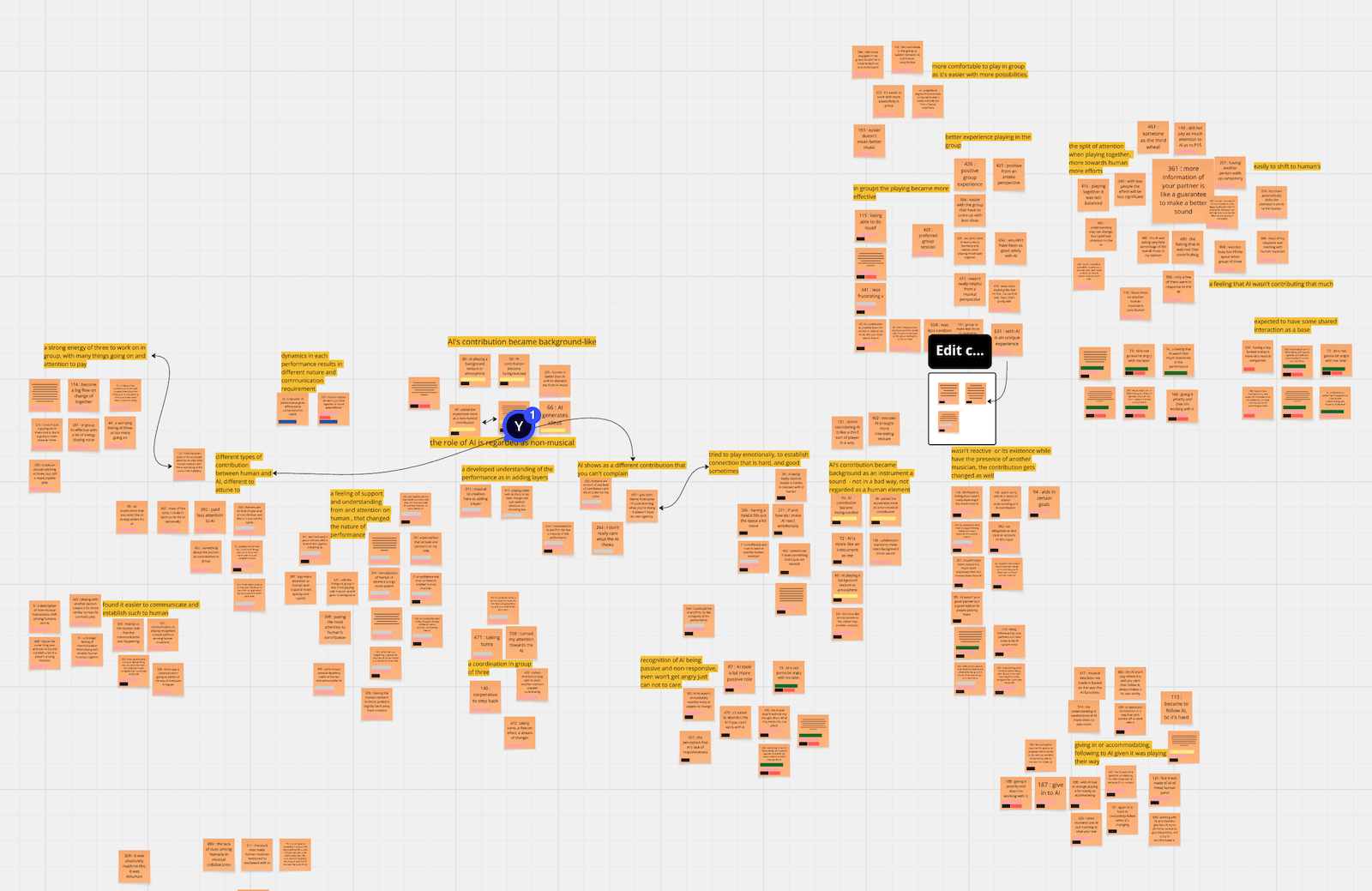
## Phase 3: Initial theme generation

A theme:

> “A theme captures something important about the data in relation to the research question, and represents some level of patterned response or meaning within the data set” ([Braun & Clarke, 2006, p. 82](#ref-braun-thematic-analysis:2006))

How do we find them?

## Themeing

<div class="columns">

<div class="column" width="60%">

In this class:

1.  Use affinity diagrams to cluster codes / data extracts
2.  Look for patterned responses/meanings (may help to write higher level codes)
3.  *prototype* themes that capture “something important” (may help to promote a code)
4.  Refine and question your themes and codes, not all themes are well-supported by data.

Byrne ([2022](#ref-byrne-worked-thematic-analysis:2022)) works through this whole process on a real data set — worth reading before the tutorial.

</div>

<div class="column" width="40%">

<figure>
<img src="img/reflexive-thematic-analysis-yichen-wang-miro-2025.png" alt="A Miro board from Yichen Wang’s thematic analysis (2025)" />
<figcaption aria-hidden="true">A Miro board from <a href="https://yichenwangs.github.io">Yichen Wang</a>’s thematic analysis (2025)</figcaption>
</figure>

</div>

</div>

## Themes do not emerge

<div class="columns">

<div class="column" width="60%">

Braun and Clarke *insist* that “themes do not emerge”, ([Braun & Clarke, 2022](#ref-braun-thematic-analysis:2022))

- themes are created by the researcher, not excavated from the data
- work goes into analysing data and deciding on themes that can be supported
- when folks write “themes emerged”, it’s as if the themes were either there to begin with or developed themselves.

Terry & Hayfield ([2021](#ref-terry-thematic-analysis:2021)) suggest approaching themeing by *prototyping*, an iterative process where “the goal isn’t to finish”.

</div>

<div class="column" width="40%">

<figure>
<img src="img/themes-do-not-emerge.jpg" style="width:50.0%" alt="Themes do not emerge is a bit of a meme." />
<figcaption aria-hidden="true">Themes do not emerge is a bit of a meme.</figcaption>
</figure>

Morriss ([2024](#ref-morriss-themes-do-not-emerge:2024)) unpacks why the phrase persists.

</div>

</div>

## Code Hierarchies

<div class="columns">

<div class="column" width="60%">

- Some TA methods suggest hierarchies of codes to find themes.
- I suggest: codes, sub- or prototype- themes, then themes
- In this example, are the themes thick or thin?

</div>

<div class="column" width="40%">

<figure>
<img src="img/reflexive-thematic-analysis_7_hierarchy.jpg" alt="(Lazar et al., 2017)" />
<figcaption aria-hidden="true"><span class="citation" data-cites="lazar-research-methods:2017">(<a href="#ref-lazar-research-methods:2017" role="doc-biblioref">Lazar et al., 2017</a>)</span></figcaption>
</figure>

</div>

</div>

## Phase 4: Develop and review themes

<div class="columns">

<div class="column" width="60%">

Are your themes good? Test them.

- Are themes supported by (enough) data?
- Answer your research question?
- Provide strong organising concepts?
- Conceptually rich? (Could you write 500 words about each?)
- Do the themes reflect the overall meaning of the data set?

</div>

<div class="column" width="40%">

<figure>
<img src="img/ella-ivanescu-EvjDP3hprI8-unsplash.jpg" alt="Are your themes bucket-y? (Photo by Ella Ivanescu on Unsplash)" />
<figcaption aria-hidden="true">Are your themes bucket-y? (Photo by Ella Ivanescu on Unsplash)</figcaption>
</figure>

</div>

</div>

## Thin vs thick themes

<div class="columns">

<div class="column" width="60%">

There are different types of themes, and a common distinction:

- Themes that categorise groups of codes: bucket themes, semantic themes, *thin* themes
- Themes that interpret the codes, revealing hidden information: latent themes, *thick* themes

(the same distinction as week 5: data summaries vs patterns of shared meaning ([Braun & Clarke, 2019](#ref-braun-reflexive-thematic-analysis:2019)))

Charles (2025; i.e., these slides!) suggests that **4** is a key heuristic for assessing theme thickness. (Disclaimer: may be revised in future!)

</div>

<div class="column" width="40%">

Number of words heuristic:

> If your theme is \<4 words, it *might* be a bit thin.

Number of themes heuristic:

> If you are proposing \>4 themes, they *might* be a bit thin.

Source: Charles, 2025. 😬

</div>

</div>

## Phase 5: Refine and name themes

<div class="columns">

<div class="column" width="60%">

- Does your theme name reflect its ‘essence’?
- Does the theme contain subthemes?
- Are your theme names descriptive but concise?
- Can you describe your theme in a couple of sentences?

</div>

<div class="column" width="40%">

<figure>
<img src="img/theme-example.jpg" alt="Theme example from Terry &amp; Hayfield (2021)" />
<figcaption aria-hidden="true">Theme example from <span class="citation" data-cites="terry-thematic-analysis:2021">Terry &amp; Hayfield (<a href="#ref-terry-thematic-analysis:2021" role="doc-biblioref">2021</a>)</span></figcaption>
</figure>

</div>

</div>

## Activity: Let’s theme

<div class="columns">

<div class="column" width="60%">

<div class="push-box">

**Do:** Let’s cluster some codes from the HCI grocery interview.

- Use this miro board link: <https://quicklink.anu.edu.au/o095>

1.  Yellow notes are “codes”, cluster them.
2.  Make red notes to represent prototype themes.

Cluster for 2-3 minutes, discuss, theme for 2-3 minutes, discuss.

</div>

<div class="warn-box">

**Careful:** this is fairly uncontrolled so be kind 😇

</div>

</div>

<div class="column" width="40%">

<figure>
<img src="img/thematic-analysis-clustering.png" alt="Miro Board sharing link (QR code)" />
<figcaption aria-hidden="true">Miro Board sharing link (QR code)</figcaption>
</figure>

</div>

</div>

## Phase 6: Write up a report

<div class="columns">

<div class="column" width="60%">

- determine the narrative for your themes
- include quotes and examples from your data
- include analysis: an argument in relation to your research question
- in your user research project: support themes with data
- in your final project: present design implications arising from the themes

</div>

<div class="column" width="40%">

<figure>
<img src="img/reflexive-thematic-analysis_8_writeup.jpg" style="width:80.0%" alt="(Ljungblad et al., 2021)" />
<figcaption aria-hidden="true"><span class="citation" data-cites="ljungblad-what-matters:2021">(<a href="#ref-ljungblad-what-matters:2021" role="doc-biblioref">Ljungblad et al., 2021</a>)</span></figcaption>
</figure>

</div>

</div>

## Reflexive Thematic Analysis Bingo ([Braun & Clarke, 2022](#ref-braun-thematic-analysis:2022))

A bingo card of potential researcher problems with (R)TA… which make sense so far?

<div class="small-table">

| B | I | N | G | O |
|----|----|----|----|----|
| Mentions inter-coder reliability | Implicitly (post-)positivist TA (not acknowledged) | More than 3 levels of themes | Mention of a lack of (statistical) generalisability | Messy mix of realism and constructionism |
| Unacknowledged social cognitions (e.g., attitude or body image) | Themes are thin - just single idea (a code) | Themes do not have a central organising concept | “Themes emerged” | Data collection stopped at “saturation” |
| Use of passive voice | No reflexivity | **Thematic Analysis** | Only Braun and Clarke 2006 cited | Mention of “bias” |
| Clarke spelled as Clark (no e) | More than 6 themes | No theory of language-treated as a window to truth | Themes are topic summaries | Very few participants quoted / over-quoting of one or more |
| Implicitly realist TA (not acknowledged) | Braun pronounced BRAWN (not Brown) | Mismatch between extracts and analytic claims | Use of a codebook | Data are just paraphrased without interpretation |

</div>

# Reflexivity

## What is reflexivity?

<div class="columns">

<div class="column" width="60%">

- turns back on or accounts for the person’s self
- analytic attention to the researcher’s role in research
- continual dialogue and critical self-evaluation of positionality
- honouring oneself and others through awareness
- thoughtful, conscious self-awareness
- using subjectivity to examine social and psychosocial phenomena
- attending to the context of knowledge production

</div>

<div class="column" width="40%">

<figure>
<img src="img/reflexive-thematic-analysis_9_reflexivity.png" alt="(Olmos-Vega et al., 2023)" />
<figcaption aria-hidden="true"><span class="citation" data-cites="olmos-vega-reflexivity-qualitative-research:2023">(<a href="#ref-olmos-vega-reflexivity-qualitative-research:2023" role="doc-biblioref">Olmos-Vega et al., 2023</a>)</span></figcaption>
</figure>

</div>

</div>

## What is reflexivity in HCI?

- researcher is a non-objective instrument! (to detect phenomena such as “user experience”, among others)
  - “an individual’s experiences and background make up a unique perspective on the world… influences how they interact with participants” ([Liang et al., 2021](#ref-liang-tensions-hci-marginalized:2021))
  - “Reflexivity calls upon researchers to self-reflect and understand their own possible biases, their role in power relations, and how these factors might manifest in their work” ([Liang et al., 2021](#ref-liang-tensions-hci-marginalized:2021))

### Positionality

- “how a researcher’s perspective compares to others’ perspectives” ([Liang et al., 2021](#ref-liang-tensions-hci-marginalized:2021))
- not necessarily about disclosing your identity
- disclosing, or examining the aspects of the researcher that is relevant to understand their situated context

## What is reflexivity in HCI?

**Burroway’s definition ([Rode, 2011](#ref-rode-reflexivity-digital-anthropology:2011)):**

1.  reflexivity, unlike positivism, embraces intervention as a data gathering opportunity
2.  reflective texts aim to understand how data gathering impacts the quality of the data itself. This approach “commands the observer to unpack those situational experiences by moving with the participants through their time and space”
3.  reflexive practitioners attempt to find structural patterns in what they have observed, and fourth, in doing so they extend theory

## Types of reflexivity

<div class="columns">

<div class="column" width="60%">

- **Personal Reflexivity:** how are our (*you!*) unique perspectives influencing the research?”
- **Interpersonal Reflexivity:** what relationships exist and how are they influencing the research and the people involved? What power dynamics are at play?
- **Methodological Reflexivity:** How are we making methodological decisions and what are their implications?”
- **Contextual Reflexivity:** How are aspects of context influencing the research and people involved?

([Olmos-Vega et al., 2023](#ref-olmos-vega-reflexivity-qualitative-research:2023))

</div>

<div class="column" width="40%">

![](img/reflexive-thematic-analysis_10_types.png)

</div>

</div>

## Statement of Positionality – Example

<div class="columns">

<div class="column" width="50%">

<figure>
<img src="img/reflexive-thematic-analysis_11_positionality_a.png" alt="(Liang et al., 2021)" />
<figcaption aria-hidden="true"><span class="citation" data-cites="liang-tensions-hci-marginalized:2021">(<a href="#ref-liang-tensions-hci-marginalized:2021" role="doc-biblioref">Liang et al., 2021</a>)</span></figcaption>
</figure>

</div>

<div class="column" width="50%">

<figure>
<img src="img/reflexive-thematic-analysis_12_positionality_b.png" alt="(Liang et al., 2021)" />
<figcaption aria-hidden="true"><span class="citation" data-cites="liang-tensions-hci-marginalized:2021">(<a href="#ref-liang-tensions-hci-marginalized:2021" role="doc-biblioref">Liang et al., 2021</a>)</span></figcaption>
</figure>

</div>

</div>

## Activity: Positionality statement (in a sentence)

<div class="columns">

<div class="column" width="60%">

<div class="think-box">

**Think:** Let’s try it:

> What is your 1-sentence statement of positionality as a researcher?

Use the poll everywhere link to provide it.

</div>

</div>

<div class="column" width="40%">

<figure>
<img src="img/polleverywhere-charles-qr.png" alt="PollEverywhere link: https://pollev.com/charlesmarti205" />
<figcaption aria-hidden="true">PollEverywhere link: <a href="https://pollev.com/charlesmarti205" class="uri">https://pollev.com/charlesmarti205</a></figcaption>
</figure>

</div>

</div>

## Why should you care about reflexivity?

- Considering researcher’s perspective is important part of developing *thick* themes.
- Needed to address challenges of subjectivity in HCI research.
- Positionality statement and reflexive consideration required for postgraduates (COMP6390) in Final Project!

## Questions: Who has a question?

<div class="columns">

<div class="column" width="60%">

**Who has a question?**

- I can take *catchbox* questions up until 2:55
- For after class questions: meet me outside the classroom at the bar (for 30 minutes)
- Feel free to ask about **any aspect of the course**
- Also feel free to ask about **any aspect of computing at ANU**! I may not be able to help, but I can listen.

</div>

<div class="column" width="40%">

<figure>
<img src="img/kambri-bar.jpg" alt="Meet you at the bar for questions. 🍸🥤🫖☕️ Unfortunately no drinks served! 🙃" />
<figcaption aria-hidden="true">Meet you <em>at the bar</em> for questions. 🍸🥤🫖☕️ Unfortunately no drinks served! 🙃</figcaption>
</figure>

</div>

</div>

# References

<div id="refs" class="references csl-bib-body hanging-indent" data-entry-spacing="0" data-line-spacing="2">

<div id="ref-alharthi-idle-games:2018" class="csl-entry">

Alharthi, S. A., Alsaedi, O., Toups Dugas, P. O., Tanenbaum, T. J., & Hammer, J. (2018). Playing to wait: A taxonomy of idle games. *Proceedings of the 2018 CHI Conference on Human Factors in Computing Systems*, 1–15. <https://doi.org/10.1145/3173574.3174195>

</div>

<div id="ref-barad-meeting-universe:2007" class="csl-entry">

Barad, K. (2007). *Meeting the universe halfway: Quantum physics and the entanglement of matter and meaning*. Duke University Press. <https://doi.org/10.1215/9780822388128>

</div>

<div id="ref-blandford-dicot:2006" class="csl-entry">

Blandford, A., & Furniss, D. (2006). DiCoT: A methodology for applying distributed cognition to the design of teamworking systems. In *Interactive systems. Design, specification, and verification* (pp. 26–38). Springer Berlin Heidelberg. <https://doi.org/10.1007/11752707_3>

</div>

<div id="ref-braun-thematic-analysis:2006" class="csl-entry">

Braun, V., & Clarke, V. (2006). Using thematic analysis in psychology. *Qualitative Research in Psychology*, *3*(2), 77–101. <https://doi.org/10.1191/1478088706qp063oa>

</div>

<div id="ref-braun-reflexive-thematic-analysis:2019" class="csl-entry">

Braun, V., & Clarke, V. (2019). Reflecting on reflexive thematic analysis. *Qualitative Research in Sport, Exercise and Health*, *11*(4), 589–597. <https://doi.org/10.1080/2159676X.2019.1628806>

</div>

<div id="ref-braun-thematic-analysis:2022" class="csl-entry">

Braun, V., & Clarke, V. (2022). *Thematic analysis: A practical guide*. Sage Publications.

</div>

<div id="ref-byrne-worked-thematic-analysis:2022" class="csl-entry">

Byrne, D. (2022). A worked example of braun and clarke’s approach to reflexive thematic analysis. *Quality & Quantity*, *56*(3), 1391–1412. <https://doi.org/10.1007/s11135-021-01182-y>

</div>

<div id="ref-corbin-strauss-grounded-theory:2014" class="csl-entry">

Corbin, J. M., & Strauss, A. (2014). *Basics of qualitative research: Techniques and procedures for developing grounded theory*. SAGE Publications.

</div>

<div id="ref-decuir-gunby-codebook:2011" class="csl-entry">

DeCuir-Gunby, J. T., Marshall, P. L., & McCulloch, A. W. (2011). Developing and using a codebook for the analysis of interview data: An example from a professional development research project. *Field Methods*, *23*(2), 136–155. <https://doi.org/10.1177/1525822X10388468>

</div>

<div id="ref-glaser-strauss-grounded-theory:1967" class="csl-entry">

Glaser, B. G., & Strauss, A. L. (1967). *The discovery of grounded theory: Strategies for qualitative research*. Aldine Publishing Company.

</div>

<div id="ref-jordan-interaction-analysis:1995" class="csl-entry">

Jordan, B., & Henderson, A. (1995). Interaction analysis: Foundations and practice. *Journal of the Learning Sciences*, *4*(1), 39–103. [https://doi.org/10.1207/s15327809jls0401\\2](https://doi.org/10.1207/s15327809jls0401\_2)

</div>

<div id="ref-king-in-vivo-coding:2008" class="csl-entry">

King, A. (2008). In vivo coding. In L. M. Given (Ed.), *The SAGE encyclopedia of qualitative research methods*. SAGE Publications, Inc. <https://doi.org/10.4135/9781412963909.n240>

</div>

<div id="ref-klein-sociotechnical:2014" class="csl-entry">

Klein, L. (2014). What do we actually mean by “sociotechnical”? On values, boundaries and the problems of language. *Applied Ergonomics*, *45*(2), 137–142.

</div>

<div id="ref-lazar-research-methods:2017" class="csl-entry">

Lazar, J., Feng, J. H., & Hochheiser, H. (2017). *Research methods in human-computer interaction* (Second). Morgan Kaufmann.

</div>

<div id="ref-liang-tensions-hci-marginalized:2021" class="csl-entry">

Liang, C. A., Munson, S. A., & Kientz, J. A. (2021). Embracing four tensions in human-computer interaction research with marginalized people. *ACM Trans. Comput.-Hum. Interact.*, *28*(2). <https://doi.org/10.1145/3443686>

</div>

<div id="ref-ljungblad-what-matters:2021" class="csl-entry">

Ljungblad, S., Man, Y., Baytaş, M. A., Gamboa, M., Obaid, M., & Fjeld, M. (2021). What matters in professional drone pilots’ practice? An\&nbsp;interview\&nbsp;study\&nbsp;to understand the complexity of their work and inform human-drone interaction research. *Proceedings of the 2021 CHI Conference on Human Factors in Computing Systems*. <https://doi.org/10.1145/3411764.3445737>

</div>

<div id="ref-mcdonald-interrater-reliability:2019" class="csl-entry">

McDonald, N., Schoenebeck, S., & Forte, A. (2019). Reliability and inter-rater reliability in qualitative research: Norms and guidelines for CSCW and HCI practice. *Proceedings of the ACM on Human-Computer Interaction*, *3*(CSCW), 72:1–72:23. <https://doi.org/10.1145/3359174>

</div>

<div id="ref-morriss-themes-do-not-emerge:2024" class="csl-entry">

Morriss, L. (2024). Themes do not emerge. An editor’s reflections on the use of braun and clarke’s thematic analysis. *Qualitative Social Work*, *23*(5), 745–749. <https://doi.org/10.1177/14733250241277355>

</div>

<div id="ref-olmos-vega-reflexivity-qualitative-research:2023" class="csl-entry">

Olmos-Vega, F. M., Stalmeijer, R. E., Varpio, L., & Kahlke, R. (2023). A practical guide to reflexivity in qualitative research: AMEE guide no. 149. *Medical Teacher*, *45*(3), 241–251. <https://doi.org/10.1080/0142159X.2022.2057287>

</div>

<div id="ref-piggott-preceptor-engagement:2015" class="csl-entry">

Piggott, T., Morris, C., & Lee-Poy, M. (2015). Preceptor engagement in distributed medical school campuses. *Canadian Medical Education Journal*, *6*(2), e21–e28. <https://doi.org/10.36834/cmej.36726>

</div>

<div id="ref-porcheron-voice-interfaces:2018" class="csl-entry">

Porcheron, M., Fischer, J. E., Reeves, S., & Sharples, S. (2018). Voice interfaces in everyday life. *Proceedings of the 2018 CHI Conference on Human Factors in Computing Systems*, 1–12. <https://doi.org/10.1145/3173574.3174214>

</div>

<div id="ref-rode-reflexivity-digital-anthropology:2011" class="csl-entry">

Rode, J. A. (2011). Reflexivity in digital anthropology. *Proceedings of the SIGCHI Conference on Human Factors in Computing Systems*, 123–132. <https://doi.org/10.1145/1978942.1978961>

</div>

<div id="ref-rogers-beyond-hci:2023" class="csl-entry">

Rogers, Y., Sharp, H., & Preece, J. (2023). *Interaction design: Beyond human-computer interaction, 6th edition*. John Wiley & Sons, Inc. <https://quicklink.anu.edu.au/kv9b>

</div>

<div id="ref-terry-thematic-analysis:2021" class="csl-entry">

Terry, G., & Hayfield, N. (2021). *Essentials of thematic analysis.* American Psychological Association.

</div>

</div>